blog description

Old women talk about old things: history, myth, magic and their
checkered pasts, about what changes and what does not.

Tuesday, November 22, 2011

Crone Imprecations & Sermons

Thanksgiving is here, and we stand at the gateway to the Dark Time. Time for a feast, my friends, before the winter, the freezing and starving throws itself, wolf-like, upon us…
That’s how it used to be. Now we have so much, we roll in gluttony and sloth, stuffing down the turkey, veg and potatoes, covering it all with heaps of gravy and ad-impregnated bouts of TV football. We continue our feast of conspicuous consumption with “Black Friday” and a day of mall-ease, staggering between over-heated stores weighed down with packages, plastic card in hand.  All the time we are striving to hold back the growing emptiness, the ancient terror of Winter, of Dark and Snowed In.
What kind of crazy world have we made when we are obliged to buy things just to keep the economy “healthy”? When did we stop being people and become “consumers?” And, oh Great Mother Earth, why do we believe we need all this stuff? On the macro scale, I fear we’re living in a sandcastle . As the bumper sticker says, “Insatiable is unsustainable,” and the tide, inevitably, will come in. 
Let's remember "Thanks" and "Giving." Instead of taking refuge in the temporary relief provided by a consumerist feeding frenzy, let’s stave off the dark with our family and friends. And let's remember to give: reach out to those with whom you’ve lost touch, send a letter to a lonely relative, visit a shut-in, drop money into the red kettle or adopt and love some sad lost soul from The Humane Society. Help make dinner at the homeless shelter.  Don't pass so much judgment upon those who don't share your beliefs or financial status. Resist the temptation to spoil your young ones by buying every little thing they desire. It’s not good for them, not in the long run, this effortless satiation of every whim.  Their adult life won't be like that.
Say a heart-felt thank-you, (not just the standard ‘thank you Lord for our food”prayer,) but a moment of  remembrance dedicated to the turkey who gave his life for you.  Later, sit down and write a letter to the editor or to your congress person about the evils of factory farming. Realize that meat should not be “cheap,” it should be healthy. The living, breathing cattle, pigs and poultry—our warm blooded relatives--should be treated with respect and consideration before they become dinner.
No matter how many good deeds we do, however, know that the old fear will still be lurking.  It’s down deep in the heart of everyone, and maybe it’s not just about Dark and Winter.  Whatever we do to face that silence, we will all, inevitably, have to confront it--the great, devouring Black Hole.  All the stuff in the world cannot fill it and no matter how fast we run, we will be swallowed in the end. 
Om Krim Kali Ma! Down to the cremation ground beside the sacred river...
So, don't spend so much time at the mall or munching by the TV. Get up early and watch the sun rise. Listen attentively to what the birds say. Go out and rake the yard before the power tool guys get out and destroy your form of Communion. Nature--sky, clouds, trees, sun, rain, our kin, our fellow creatures—these are our real treasures, the eternity-in-the-now which makes life worth living, which shines our little, conscious candle into the face of all-conquering night.

Friday, November 18, 2011

Witch Trials of Virginia

In North America, most people think of Salem when witch trials are mentioned, but Virginia has the dubious honor of holding the first such trial on the continent. Thirteen women and two men are known to have been tried for the crime. Thanks to the Civil War, many records were likely lost, but most of those accused were found not guilty and often turned the tables on the accuser by successfully suing for defamation of character.

In September 1626, Joan Wright was the first person in Virginia to have been tried for being a witch. Goody Wright was most likely a cunning woman. Because few in the seventeenth century could afford physicians and those who could often didn't trust them, cunning folk were popular healers for the masses. Joan engaged in foretelling the future and was a midwife. Also, she was left handed, which further helped her accusers to place blame on her being in league with the devil.

On at least three occasions, Joan prophesied that certain individuals would bury their spouses, which indeed came to pass. In another case, she attended the birth of Lieutenant Giles Allington's wife. Due to Joan's left handedness, Allington's wife distrusted her and a second midwife also assisted.

After the delivery, the woman grew sore in the breast (most likely an infection) and was bedridden for weeks. Soon after, the lieutenant himself fell sick as did the child. Goody Wright was accused of witchcraft for these incidents and several others. The record is unclear as to what punishment, if any, she might have received, or even if she was found guilty. However, she was fined one hundred pounds of tobacco for an unspecified act.

Katherine Grady has the unfortunate distinction of being the only person executed in the colony for the offense. In 1654, she was en route from England to Virginia when a violent storm hit. Such disturbances were often associated with witchcraft. Of the passengers, Kath Grady, an elderly woman, apparently best fit the description of a sorceress. Detailed accounts either went unrecorded or were lost, but the captain hung the woman during the storm. Although technically she hadn't arrived on Virginia's shores, the case fell under its jurisdiction, where the captain reported upon reaching the Jamestown port.

Reverend David Lindsay emigrated from Scotland, a country with many witch trials, and accused William Harding of witchcraft in 1656. Harding was sentenced with thirteen lashes of the whip and ordered to leave the county. The records fail to reveal why he had been found guilty.

Other cases included the usual bewitching of horses, cows, and chickens. Some women were inspected for witch marks on their bodies, but only one other case had any serious accusations. The most famous witch in Virginia's history is Grace Sherwood. Like many women charged with being witches during the seventeenth century, she was a nonconformist. Said to have been strikingly attractive, she fully admitted to being a healer, herbalist, and a midwife. She owned prime waterfront property and wore trousers when she planted crops.

Her troubles began in February 1698. A neighbor, Richard Capps, had spread gossip that Grace was a witch. With her husband's help, she sued Capps for slander. An agreement was likely worked out as the suit was dismissed soon after.

Six months later, Grace again faced accusations. John Gisburne (a constable of Princess Anne county) and his wife Jane claimed that Grace had "...bewitched their piggs to death and bewitched their Cotton." At the same time, Elizabeth Barnes vowed that Grace had come to her during the night and rode her. She went onto say, "...[Grace] went out of the key hole or crack of the door like a black Catt."

Once again, Grace and her husband sued for defamation of character. The jury found for the defendants, and the Sherwoods were left to pay the court costs.

James Sherwood died in 1701, leaving Grace with a small estate. In 1706, she got into a fight with a neighbor by the name of Elizabeth Hill. Grace ended up suing Elizabeth and her husband Luke for assault and battery. The justices awarded her twenty shillings in damages.

The judgment was a small portion of what Grace had sued for, but the Hills brought accusations of witchcraft, saying that Grace had bewitched Elizabeth. In March, a jury of women searched Grace Sherwood with these findings, "two things like titts wth Severall other Spotts." The forewoman of the jury happened to be Elizabeth Barnes, the same woman who had been involved in a slander suit a few years earlier.

As a result, Grace's case went to the General Court and Attorney General. The charges were returned to the county level with the suggestion that a jury of women again search Grace as well as her house. The jury refused to appear.

In July, the county wished to settle the affair once and for all, and the justices ordered the sheriff to try her by ducking. Later in the month, Grace was led from her cell where a crowd gathered, chanting, "Duck the witch!" She was stripped to her shift, then tied crossbound with the thumb of her left hand to the big toe of her right foot, and her left thumb to her right big toe. From a boat, she was lowered in a pond, where she floated and was found guilty. Brought to shore, she was searched by a jury of woman. Again, they discovered the two suspicious moles.

Grace was taken into custody. After her release in 1714, she paid the back taxes on her property. Apparently afterward, she lived a quiet life. A will was found dated 1733 and probated in 1740, where she died at the age of 80. On July 10, 2006, 300 years after Grace's ducking, she was pardoned by the 70th Governor of the Commonwealth of Virginia, Timothy M. Kaine.

Kim Murphy
www.KimMurphy.net

Wednesday, November 16, 2011

Hammer

It will be a year, on the 20th of November, since me ole pa crossed over to the other side. He was a crusty fellow, something of a combination of Carroll O'Connor, Ed Asner, and Jack Nicholson, with a touch of John Wayne thrown in for good meaure. He was a working class man with a grade 8 education who got up at 4:30 a.m. most mornings and worked like hell all day. He gave his family great love and earthy wisdom—-oh pillar of patriarchy! At the same time he was unembarrassed for anyone to see him cry. He lived life on his own terms, and he truly lived. He died well, too, surrounded by his family, the huge meaty bear paws of his hands spread out peacefully before him on the hospital blanket that covered his bed. In his honour, I'd like to offer up the eulogy I gave for him at one of the best damn wakes I've been to in a long time. Good on ya, Alvin Lloyd Corlett, Jr.! You taught us what it is to drink the sweetness of life.


HAMMER


They say that in the time before we are born
there is a place we go to choose our gifts,
the things we bring with us to dance us through life
And I was told
that you chose the hammer
—the hammer—
that made me smile,
considering the Manx origins of your name
Corlett—Mac Thorliot—Thor's People,
–or so the stories go—
Visions of large, bellowing men pounding things
immediately sprang to mind.
Not completely inappropriate...
but hardly the sum total of your life.


The hammer is a hard day's work
the essence of your creative spirit
the determination, the force of will and warrior grit
you brought to everything you did
If it was a mountain, you'd still say "It ain't gonna lick me,"
and give it hell 'til you'd whittled it down to a stone


You taught us that, too
Made it a physical lesson
Hours spent drilling a softball
Into a thin leather glove
"Stop your bawlin'. Catch it right, in the pocket,
And it can't hurt you."
We'd catch the spirit of the thing,
Try and avenge our throbbing hands,
Whip it back at you for all we were worth
swallowing the tears
Just for the reward,
the goofy face you'd make
if we could get that ball to sting you back.


The hammer is the smith's tool
Instrument of transformation
Making red hot metal something new
With just one skilled and elegant swing
You brought that kind of magic
To simple things
Showed us the joy
Of dancing in the rain
The beauty of a birdsong, a river, a star
The depth of laughter in the eyes
Of the woman you loved.


Sometimes you swung your hammer like a child
You couldn’t contain your enthusiasm
Racing Al down the Albuna townline
Damned if you were gonna let him win
Or the time you got your first pontoon boat
It was skidoo suits in April on the river
There was still snow on the banks
And you were grinning like a fiend


Other times you were epic
Like when you dove over a couch
Out of a dead sleep
To put out a grease fire at the Homestead
Or when you almost kinda sorta jumped the ditch
On your snowmobile
You had bruises for weeks
That’s why they called you “Crash.”


And if a hammer smashes things
Sometimes they’re things that need smashing,
Like the fear of saying what your heart really feels
The fear of love—or tears


And now
When finally your hammer has fallen from your hand
What are we to do?
It lies there on your workbench in quiet testimony
Echoing still of the many things you created
And I think I hear you whisper
Just live
And let that be enough
Do it fully
From the inside out
Dance, like a red pine in the breeze
Singing old secrets
That make us smile

Friday, November 11, 2011

A Soldier’s Breakfast by Jude Pittman

(Jude Pittman's story was originally published in

Western People Magazine, May1991 as Egg on His Face)


Bill was in his glory. Finally after weeks of courting young Phyllis Quelch, he'd been invited home to dinner. He pressed his uniform until the creases cut and shined his shoes until he could see his reflection.

Bill wanted to be sure that the Quelches recognized him as a serious young man with his own land and big plans for the future. Once the war was over he'd be returning to his homestead in Alberta, and it was going to take some doing to convince Phyllis to give up her life in England for the rough Canadian prairies. This dinner was Bill's chance to win the Quelches approval, and when he met them at their humble cottage he flashed his brightest smile and prepared to charm them with his native Canadian wit. The Quelches were a pleasant couple slightly reserved in the manner of the British but they soon warmed to Bill and after dinner they invited he and Phyllis to join them at the neighborhood pub.

The evening passed in easy camaraderie. Bill entertained the Quelches with amusing tales of life on the Canadian wilderness, and they responded with anecdotes of English country life. By the time they started home it was raining heavily, and Mrs. Quelch insisted that it was not a fit night for Bill to bicycle back to the base. He gratefully accepted a bed on the living room sofa and was soon fast asleep.

Rising early the next morning to the smell of sizzling bacon, Bill slipped into the little kitchen to greet Mrs. Quelch.

"The top o'the mornin to ya," he quipped. "When I heard you humming away at that stove I thought for a sec I was back home with my Mum."

Smiling shyly, Mrs. Quelch poured him a cup of tea, dished up several slices of bacon and four eggs onto an old crockery plate and set it carefully on the warmer.

"That smells mighty good, ma'am," Bill said, gratefully carrying the plate to the little breakfast nook and happily digging into his breakfast. The portion was just right for his vigorous appetite, and pleasantly filled, he waited eagerly for Phyllis and her Dad to join them. When they finally gathered around the table, Bill wondered that all they ate was toast and tea, but assumed they'd adopted the modern habit of saving their appetite for the mid-day meal.

When Bill prepared to leave for the base Phyllis offered to ride part way and Bill delightedly accepted her company. They hadn't gone far though, when she stopped her bicycle and turned to him with a serious expression on her face. "Bill," she said. "Have you any idea what you've done this morning?"

"Done, why I haven't done anything at all, other than pass the time of day with your Mum and enjoy her fine breakfast."

"That's just it. You ate the entire family's ration of bacon and eggs this morning. We save our eggs all week long so on Sunday morning's we'll have enough to share at breakfast."

Well, the ground should have opened up and swallowed Bill. Never had a young man been so embarrassed. Back home in Canada--what with their own hogs and chickens--it was nothing to eat a rasher of bacon and six or seven eggs for breakfast. It hadn't even occurred to him that the plate Mrs. Quelch put on the warmer was for anyone but himself.

Bill's face flamed. He mumbled his apologies to Phyllis, bid her good day, and pedaled like a madman to the base. Wheeling in through the gates he headed straight for the mess hall. Bill had long been in the habit of offering a helping hand in the kitchen when no one else was willing, and his easy acceptance of even the meanest chores made him a favorite among the cooks. Therefore, when he reached the mess hall and tossed his knapsack in the door he was met with good natured grins.

"Fill 'er up lads," he said. "Whatever we've got to spare and don't stint the bacon and eggs. I've a debt to repay and I'll be thanking you not to make me look bad."

Next, Bill charged across the compound and descended on the warrant officer. "Sir, every month we're entitled to our ration books." he told the startled officer, "and in all these many months I've not drawn any of mine. This morning I made a colossal donkey of me, what with not knowing how hard-up these people are for food, and I'm sure in need of my ration books."

"Well soldier," the officer replied, "you're certainly entitled to them, but it'll probably take a little time for me to round them up."

"That'll be fine Sir. I've a few things to attend to and then I'll be back to pick them up."

With that Bill headed back to the kitchen, and finding the knapsack filled to overflowing, he thanked the cooks and swung the heavy knapsack onto his shoulders.

When the ration books were ready, he shoved them in his pockets, and fetched his bicycle. Then he pedaled furiously for Maidenhead and was soon knocking on the door of the cottage.

"Why Bill," Mrs. Quelch said, when she answered the door. "Whatever brings you back here this morning."

"There's a little matter I need to attend to," Bill said stepping inside the door and heading for the kitchen. "You know ma'am," he said, removing the knapsack from his shoulder. "I've never been so embarrassed in my life as when Phyllis told me I'd eaten the family's breakfast. Now, I'm hoping you'll let me makes amends."

Stunned, Mrs. Quelch's eyes widened in wonder as Bill began spilling the contents of his knapsack across the kitchen table. Then, turning to the astonished woman he reached in his pockets and pulled out the stack of ration books.

"Mrs. Quelch," he said. "I want you to know that as long as I'm around here there won't be any more breakfasts of dry toast and tea," and Phyllis, coming into the kitchen, watched in amazement as her mother burst into tears.

"You know," she told Bill later, "in 21 years I've never seen my mum cry, and I'll never forget what you've done for her today."

Wednesday, November 9, 2011

Sapper Day

You died
And spring became winter
A March snowstorm
Blanking the muddy Earth
Like the years blank memory
You were a man of the First Great War
A sapper
You ran tunnels
Beneath the heaving battlefields
So when your time came
You were no stranger to mud
Or to Gaia


You are typed words
In an archived file
Odessa, Russia, 1892
Crystal Beach, Ontario 1917
Jewish
Complexion dark, eyes brown, hair black
5 feet 5½ inches
Hearing O.K. Nose & throat O.K.
You had a beer in '57
At a Kitchener Legion Hall
With your great-nephew after he joined the Navy Reserve
You enjoyed showing him off in his uniform


There is a cross on your grave
Just like all the others
In your army-neat row
Opposite an old stump
At the cemetery
George Day
Sapper
March 9, 1959
At first when we went looking
We thought Sapper was your middle name
For we are children
Of a later but less immediate age


Behind your stone
The imprint of a workboot
Pressed deep in the concrete
Evidence of the human need
To keep you upright
Evidence
of a coarse respect
We take digital photos
For your great-nephew
Whose memory is not blanked by snow
And I stretch on your grave to honour Gaia,
Who holds you curled in Her quiet fist

Monday, November 7, 2011

Crone.Choices


Come with me
There's work to do
NO
Come with me
There's time to play
To wander by river spirals
To dream, to pray…
Come with me
There's work to do
NO
Come this way

WORK… there's never an end to it, although there are so very many more interesting things to do, places to go. I don't need to go far to be in another world. A walk by the river will do it for me, or even reading certain poems by Mary Oliver.
Would a Wise Crone know how to get everything done? Or would she have the Knack of Knowing what her priorities were to keep all and everything and every need in balance?
When the dust settles heavy across the ledges, and the cooler is saying disgusting things then the river spirals must wait. But not for long.

Sunday, November 6, 2011

Dedicated to our glorious war dead

Because there lie between us
Hundreds of miles of sleeping fields,
Collapsing barns,
Desolate railroad crossings,
Solitary grain elevators,
Armfuls of birds ascending from
telegraph wires,
And depthless blue ponds staring
blindly at the sky,
I spend too much time with your
written words,
As sparse and sere as leaves left
on November trees,
And your digital daguerreotype,
The one you made for someone
else.
You look into the camera in sepia:
Thin-lipped mouth in crooked smile,
long black hair,
A hardened soldier of many
campaigns.
All you need is a forage cap and
rifle
To have been part of some Irish
regiment decimated at Gettysburg.
But I think of you alive --
The smell of burning leaves on your
freckled skin,
And the taste of ginger molasses
in your mouth
As you plunged valiantly through
the parted gates of heaven.
Now, war widows return alone to windswept
farmsteads or
Faded-brick Italianate houses on
the edge of town,
There to impale themselves again
and again
On the bayonet of remembrance,
So they can finally be stunned,
like Paul at Damascus,
By the blood-red garnet sunk deep
inside that will sustain them.

Wednesday, November 2, 2011

My Burford Ghost


Ghost story time, now that it’s October/November again. On this Day of the Dead, I’ll tell one of mine, from the time when I was a teenager, traveling with my mother in England.

We arrived in the beautiful Cotswold town of Burford in her new green Morris Minor station wagon, heavily loaded with what we would soon come to realize was all our remaining earthly possessions. We entered an old hotel (I think it was The Bull) right on the main street. The place had actually had been there since 1658, and we drove our car in under an ancient stone-clad arch into a courtyard.

There’s a particular color to Cotswold villages. All the stone has a gray-gold cast, as if you’ve entered a dreamtime of the past. (Of course, 1658 is pretty “young” by UK standards, but you’d have to be on the east coast in New England in the States to find any building near that age.)

I ended by myself in a room on the third floor, something of a paradise for an introverted teen. It was still summer and high tourist season, so the hotel was full. This floor was not well lit and creaky and full of heavy walnut stained furniture both clumsy looking and authentically ancient. There was a smell too, of old wood, mold and furniture polish. The loo was down the hall, but I loved the room and the huge heavy headboard of the bed. I planned to have supper with Mom, walk up and down the high street while there was still light and soak in the atmosphere, then retreat to the room to read and sleep. Best to leave Mom to her inevitable saloon bar revels.

The hallway floor had plentiful creaks, so I managed to time my last visit to the loo when no other guest was about. Then, locking the door, I climbed into the high bed and cheered myself up with the thought that I was – as I’d so often imagined – in England, in a stately sleeping chamber of the past, like a privileged lady in the historical novels I loved. Outside, people came and went more or less quietly. I went to sleep.

Next thing I knew, I was standing in the hall, a few steps beyond my door. The light had apparently gone out because it was pitch black. I was in my flannel nightgown. It was confusing, because I didn’t know how I’d got there, and besides, it was uncomfortably cold.

That was when I saw him, a gentleman with a moustache and beard, wearing a hat with a flowing plume and dressed in Restoration-over-the-top garb. Weirdly, he was visible only to the shin. He bowed, removed his hat, and greeted me, saying that he was an ancestor who had been waiting there in Burford to see me for quite a long time.

I shivered. The ghost hadn’t threatened, but it was so dark and so other and the man I was looking at had a sort of glow beneath his colorful threads. I’d slipped, I think, through a crack in time.

I was ready to run, but then, like a skipping track on a CD, I was standing next to the modern day drab wallpaper, in a hallway inadequately illuminated by that one yellowish bulb. Yes, I was in my nightgown; yes, it was icy cold, but my visitor was gone. I dashed back to my room, slammed the door and locked it, then jumped into bed and pulled the covers over my head. I thought I’d never go to sleep again, but I did.

The next morning I washed my face, got dressed and went downstairs. The hallway looked a bit brighter now with daylight coming through the distant street side window. Mom was already at breakfast, which was a sign she hadn’t stayed up too late or gotten into any kind of trouble. I joined her, hardly waiting till I sat down to tell her about my encounter. She loved this sort of thing, although she claimed to be too hard headed to have ever encountered anything otherworldly.

The host, who had been on the other side of the room, stopped what he'd been doing and came hurrying over. Drawing a chair up to sit with us he directed, “Please whisper! He hasn’t been up there for months, but he’s not good for business, so I don’t want it to get around that he’s back.” (Some different from the 21st Century, huh?) The host asked me to go back to the beginning of my story and then nodded as I told it, muttering, “Yes, yes. That’s him, just as I’ve seen him myself.”

He seemed particularly interested when I mentioned the apparition’s missing feet. “That’s because he’s standing on the old floor,” he explained. “Ever since we redid third story and covered the old warped floor, he’s been chopped off like that.” He also thought it was odd that the ghost had claimed to be an ancestor, because “Usually he doesn’t speak.”

And so that’s my Burford ghost story. I never did see the Restoration gentleman again, although we stayed there for several days more, touring round the Hobbit village perfection that is the Cotswolds.

Friday, October 28, 2011

Pilgrimage


This year I made it back to a place I’ve been dreaming about for a decade, Avebury in Wiltshire, UK. There is a vibe, something about the plain and the high rolling downs which draws people in, and whatever that something is, it’s been active since before the Neolithic.  Today there are crop circle and ley line hunters, but this is an ancient holy site. The area contains the remains of Mesolithic “towns” as well as barrows, ditches , dikes and standing stones, all created with antler picks, woven handbaskets and ropes made of hair and plant fiber and human hands over a period which lasted well over two thousand years. On a bright autumnal day, Avebury still draws tourist crowds, although nothing like its neighbor, Stonehenge, standing proudly among its own barrows and earthworks just twenty miles to the south. 
The first time I visited, I was fortunate enough to get a room in the finest B&B in town, in a 17th Century house with a view of the north circle which served a “smashing breakfast.” From there, I planned to walk a single day of 13 miles on the 5,000 year old Ridgeway, to feel the “road goes ever on and on” beneath my feet. I was seriously out of shape, and, although I didn’t know it, on the verge of a life-threatening illness. I didn’t even have a map. Such was my crazy “plan.” I was determined to see it through. 
I had supper at the Red Lion Inn which sits in a crook of the busy highway running straight through the holy place, and went early to bed. Beyond the back fence, visible from my window, was a ditch, a  corresponding dike and a few of the remaining limestone behemoths, part of a once mighty circle.  And as might be expected in such a place of power, I had a dream. In it, one of the big gray stones behind the house slipped its moorings and came through the garden to stare through the window at me. It was a cold, old presence, terrifyingly “Other,” like something out of H.P. Lovecraft, but it was oddly disinterested, too. I was a bug, perceived through the prism of time.
I saw the stone. The Stone saw me.
I sat bolt upright, rigid with fear, every hair on end, but of course, nothing was  there.   Outside my window was dripping dawn and an October fog which would soon become rain, providing this foolish pilgrim with the requisite ordeal.  Later, as I climbed the green Herepath, the ancient trail which leads up a side-aching escarpment to the Ridgeway, I turned and looked back toward the magical remains of  avenues and circles. I still wanted the adventure, the ordeal of the long walk on already bruised and inadequately shod feet, but such a feeling of sorrow as I gazed down upon the ruined sanctuary! I knew, beyond a doubt, that someday I would make a dedicated journey, spend whole days walking with the ancestors among those charged, still wide-awake,  stones.

--Juliet


Tuesday, October 25, 2011

Keats's Autumn

At least one Romantic may have found a rare appreciation for the Mother in Mother Nature. In Keats's poem "To Autumn," he personifies the season as a matured friend of the sun. The imagery, scents, and sounds of Autumn are o'er-brimmed by Summer and pour from Keats's pen in sensitive and intimately familiar words. Autumn is careless, drowsy, and patient. Autumn loads vines, plumps gourds, and pauses mid-harvest to spare flowers still budding for the bees. Certainly the Seasons were traditionally given female identities, but Keats never names his Autumn's gender. Instead he introduces a force of nature, and allows the reader to fill in the picture. I'm pretty sure Autumn is a woman - a rosy, mellow, beautiful woman; I feel certain Keats agrees.

47. To Autumn

S
EASON of mists and mellow fruitfulness,
Close bosom-friend of the maturing sun;
Conspiring with him how to load and bless
With fruit the vines that round the thatch-eves run;
To bend with apples the moss’d cottage-trees,
5
And fill all fruit with ripeness to the core;
To swell the gourd, and plump the hazel shells
With a sweet kernel; to set budding more,
And still more, later flowers for the bees,
Until they think warm days will never cease,
10
For Summer has o’er-brimm’d their clammy cells.
2.

Who hath not seen thee oft amid thy store?
Sometimes whoever seeks abroad may find
Thee sitting careless on a granary floor,
Thy hair soft-lifted by the winnowing wind;
15
Or on a half-reap’d furrow sound asleep,
Drows’d with the fume of poppies, while thy hook
Spares the next swath and all its twined flowers:
And sometimes like a gleaner thou dost keep
Steady thy laden head across a brook;
Or by a cyder-press, with patient look,
Thou watchest the last oozings hours by hours.
3.

Where are the songs of Spring? Ay, where are they?
Think not of them, thou hast thy music too,—
While barred clouds bloom the soft-dying day,
And touch the stubble plains with rosy hue;
Then in a wailful choir the small gnats mourn
Among the river sallows, borne aloft
Or sinking as the light wind lives or dies;
And full-grown lambs loud bleat from hilly bourn;
Hedge-crickets sing; and now with treble soft
The red-breast whistles from a garden-croft;
And gathering swallows twitter in the skies.


John Keats (1795–1821). The Poetical Works of John Keats. 1884.

http://Bartleby.com; 25 October 2011.

Thursday, October 20, 2011

Chutzpah by Lari Jo Walker

Chutzpah – or “You can't get there by bus, only by hard work and risk and by not quite knowing what you're doing, but what you'll discover will be wonderful. What you'll discover will be yourself.” - Alan Alda

Climbing the tree was the easy part. The hard part was not allowing herself to stop and sample the fruit. The aroma was stronger here than in the shaded lawn below, but not unpleasant. In fact the scents of apples and peaches mingled seamlessly into an essence all their own. Three months earlier it had been cherries, which blended in with the pears toward the end of their season. She had marveled at this tree for the last twenty years but never had the chutzpah to climb it.

Chutzpah. She was thinking of words like that. Had she said it out loud? Her day was becoming as remarkable as the tree.

Obviously it had been grafted, several times if the variety of fruits the tree bore was any indication. She had never heard of such a thing. Nor had she considered it unnatural during the many years she had lived in the house at the edge of this grove. Or copse? If a tree had chutzpah, would it live in a grove, a copse, or a woods? These thoughts were really becoming annoying. She concentrated on pulling herself up to the next branch.

She had watched the tree grow and flower, drop petals, fruit, and leaves in a perpetual cycle for these many years. A part of her had always loved the tree. When she looked at its outline in whatever season, she always thought, “That is the perfect tree.” Especially in winter. Its branches rose gracefully, in perfect balance with each other. She had often thought about drawing the tree during winter, the way the art teacher had taught her in fourth grade. Starting at the roots, you drew a tree the way it grew – from under the ground up to its branches, the many branches forming a thicker trunk with each line. One line of the living tree had a beautiful curve where it forked away from the trunk. It occurred to her that she had been watching this tree from the bedroom window in her house at the edge of the woods for so long that she knew it as well as her hand – each swollen knuckle and age spot. The image of the tree blended seamlessly into the history of her life in this place.

She paused to get her bearings. It seemed she had been climbing for hours, but that couldn’t be true. She moved a small branch aside to try and see how far she was from the ground. But the leaves were so thick she could see neither up nor down through the breathing green around her, broken sporadically by a red apple or glowing peach. It was so relaxing to be here, with no sense of in or out, East or West, come or go. She knew only that she was above the earth and below the sky, feeling her hands and the soles of her feet meet and nearly embrace (if they could not encircle) the living bark of the tree. And suddenly she was aware of the house. The tree house she had glimpsed from her house just this year.

The house had been her goal at the start of her climb, but she had become so enthralled by the fruit and then her thoughts that she had almost forgotten about it. Now that she was here, she remembered why she had come – or climbed. She knew that the house was nearly at the top of the tree, so she must be at least 40 feet in the air.

“Thirty-seven, actually.” A face appeared at the window of the house. “Thirty-seven feet, dear. Very tall for a fruit tree, don’t you think?”

She jumped a bit, and one foot slipped from the branch she was resting her feet on. She had already sat down – or against – one of the larger branches, thank God. She might have fallen, otherwise.

“ Oh, so sorry I startled you. I was sure you knew I was here, or why climb this tree? The fruit is lovely, but it does fall when it’s ripe – so climbing is truly unnecessary. I expected you wanted to have a visit, meet the new neighbor type thing.”

“Yes. Yes, I believe I did want to see who was here – who built this house. It’s been such a strange day I had forgotten that was what I was doing. I do that a lot lately. So, this is your tree-house, is it?”

“Tree, house, words are such malleable creatures. The two ideas seem as unlikely a combination as winter and branches, but they blend - seamlessly in this case – to form a new idea altogether. Have you noticed that about words?”

“Yes. Yes, in fact, I had noticed again, lately. I used to play with words nearly all the time. But I hadn’t thought about it at all until recently.” She suddenly realized she had been thinking about writing again, although she couldn’t say when or how she thought of it at all. That, and she had just said “yes” more times in a minute than she had in a year.

“Well,” her strange new neighbor said, “writing takes chutzpah, you know. I think you may be finding you have more chutzpah than you ever imagined.”

“Yes,” she replied, “I do believe I have chutzpah. And I may have learned it from this tree!” And then she realized that what she had said sounded absurd, but she didn’t mind that at all. And she was smiling.

Thursday, October 13, 2011

My favorite Autumn and Crone images


In no particular order . . . my favorite Autumn and/or Crone images for the season.
(With apologies for being so late with my posting. Been swamped with a new job!)


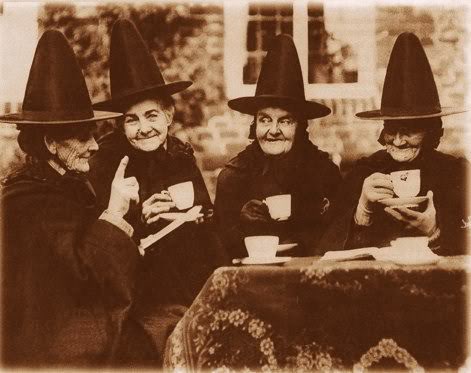
Have loved these Welsh ladies from the first time I spotted them on a postcard and shared them with my "goilfriends." Did some reading into the history of their hats (wonder if they ever had a clue they looked like witches in them?!) and learned that they first appeared in the 1830s and were likely adapted from men's hats of the period.


I stumbled across this image when I started researching "Crones" in art. At the same time I found this, I read that grandmothers were usually the designated storytellers. This painting by the French artist Louis-Leopold Boilly is entitled "and the Ogre ate him up!" (early 19th c.)
Love the expressions on the faces of the children!


John Everett Millais' "Autumn Leaves" (1856).

Fall, leaves, fall

BY EMILY JANE BRONTË
Fall, leaves, fall; die, flowers, away;
Lengthen night and shorten day;
Every leaf speaks bliss to me
Fluttering from the autumn tree.
I shall smile when wreaths of snow
Blossom where the rose should grow;
I shall sing when night’s decay
Ushers in a drearier day.

Source: Poets of the English Language (Viking Press, 1950)

~~~~~~~~~~~~~~~~~~~~~~~~~~~~~~~~~~~~~~~~~~~~~~~~~~~~~~~~~~~~~~~~~~~~~~~~~~~~~~

Sunday, October 2, 2011

This isn't your mother's menopause

Maybe I've always had too much testosterone to go gently into menopause by nagging for grandchildren, puttering in the garden and waxing nostalgic over crap that happened 30 years ago. My menopause feels more like a certain type of man's -- not the guys who go all soft and contemplative in their dotage, but the stereotypical silver fox in the Ferrari he can finally afford, cruising sweet young 40-somethings at the upscale bar. Ouch; yes, I'm that guy.

I went through a mopey period. Ten years of a mopey period, to be exact. My weight ballooned. Everything ached. I could only find a special occasion dress in the fat woman's department at Nordstrom's. I'd stand in front of my kitchen window and watch people jogging, biking, being alive, and think, "Gee, that used to feel good. That used to be fun. I can't believe I used to do that." Then I'd waddle back into the family room with a bag of chips and watch more television. It didn't matter. I was old; old people are supposed to act this way. On days when the estrogen was especially volatile, I would shift into manic phase by yelling and throwing things. I was like Liz Taylor in her later days, only without the bling--so actually like Liz Taylor as Martha in "Who's Afraid of Virginia Woolf," only without the sex.

The wakeup call for me was seeing the pictures from my best friend's daughter's wedding. Even fully made up and dressed to the nines, I didn't just look old, I looked dead. Well, yes, I may be old, but I'm not dead yet.

So over the past year I stopped dyeing my hair, lost 40 pounds and rediscovered physical activity -- biking, skating, jogging, kickboxing and recreational sex. I'm successfully passing for 10 years younger than I actually am, and yes, I fully intend to continue the deception for as long as I can get away with it (harder than you think; when I say I remember the '80s, I have to foster the illusion that I remember them as a high school student, not as someone who actually voted for Michael Dukakis, even though I have the campaign buttons to prove it).

In one way I guess I can say I'm rediscovering the essential self that got set aside--physically when the procreative imperative took over at puberty, and mentally/emotionally after I became a mother. In another, deeper way, however, I'm morphing into the woman I was meant to be all along -- the woman that isn't fettered by the fears, insecurities and self-consciousness that go along with being young. I'm too damn old to give a fuck what people think of me. And that's a healthy attitude for any age.
Has all this second-adolescence activity made me a less contemplative, more shallow person? Perhaps. But since I already went through old age during my real adolesence (oh so much bitter reading of Herman Hesse, writing bad poetry and simultaneously mocking and envying my popular classmates!), it seems to be balancing out perfectly.

As far as being a wise crone dispensing sage advice, unless I can look and act like Maria Ouspenskya counseling Lon Chaney, I'm not interested. Yes, you can ask me for advice, but my responses are less likely to sound like the Dalai Lama and more like Coach Mike Ditka: get off the cross, man up, and tighten up that offensive line. (That's another weird thing about menopause: Along with the relentless hot flashes, in the last year I've also developed and taste for an an understanding of football.) And of course, the ever-popular, "You need to get laid."
Heck, it worked for me.

Friday, September 30, 2011

The Summons


Snaky necks black
Among cornshocks
Be-In of clans,
Feathered coverlet,
Mulched field
High blue above,
Walking, chatting, resting.

Some fly in,
Wings bowed
Dump speed for landing.
Some fly out,
On their way to
Lost Pangea.

As it is,
So it was.
Faithful through eons,
Through cataclysms of
Fire,
Frost,
And our slaughter,
Hearing, beyond
Man's stunted senses,
Magnetic Summons--

Fly Now,
Oh Brave Children
Of Archeopterix.


http://www.julietwaldron.com