blog description

Old women talk about old things: history, myth, magic and their
checkered pasts, about what changes and what does not.

Friday, October 28, 2011

Pilgrimage


This year I made it back to a place I’ve been dreaming about for a decade, Avebury in Wiltshire, UK. There is a vibe, something about the plain and the high rolling downs which draws people in, and whatever that something is, it’s been active since before the Neolithic.  Today there are crop circle and ley line hunters, but this is an ancient holy site. The area contains the remains of Mesolithic “towns” as well as barrows, ditches , dikes and standing stones, all created with antler picks, woven handbaskets and ropes made of hair and plant fiber and human hands over a period which lasted well over two thousand years. On a bright autumnal day, Avebury still draws tourist crowds, although nothing like its neighbor, Stonehenge, standing proudly among its own barrows and earthworks just twenty miles to the south. 
The first time I visited, I was fortunate enough to get a room in the finest B&B in town, in a 17th Century house with a view of the north circle which served a “smashing breakfast.” From there, I planned to walk a single day of 13 miles on the 5,000 year old Ridgeway, to feel the “road goes ever on and on” beneath my feet. I was seriously out of shape, and, although I didn’t know it, on the verge of a life-threatening illness. I didn’t even have a map. Such was my crazy “plan.” I was determined to see it through. 
I had supper at the Red Lion Inn which sits in a crook of the busy highway running straight through the holy place, and went early to bed. Beyond the back fence, visible from my window, was a ditch, a  corresponding dike and a few of the remaining limestone behemoths, part of a once mighty circle.  And as might be expected in such a place of power, I had a dream. In it, one of the big gray stones behind the house slipped its moorings and came through the garden to stare through the window at me. It was a cold, old presence, terrifyingly “Other,” like something out of H.P. Lovecraft, but it was oddly disinterested, too. I was a bug, perceived through the prism of time.
I saw the stone. The Stone saw me.
I sat bolt upright, rigid with fear, every hair on end, but of course, nothing was  there.   Outside my window was dripping dawn and an October fog which would soon become rain, providing this foolish pilgrim with the requisite ordeal.  Later, as I climbed the green Herepath, the ancient trail which leads up a side-aching escarpment to the Ridgeway, I turned and looked back toward the magical remains of  avenues and circles. I still wanted the adventure, the ordeal of the long walk on already bruised and inadequately shod feet, but such a feeling of sorrow as I gazed down upon the ruined sanctuary! I knew, beyond a doubt, that someday I would make a dedicated journey, spend whole days walking with the ancestors among those charged, still wide-awake,  stones.

--Juliet


Tuesday, October 25, 2011

Keats's Autumn

At least one Romantic may have found a rare appreciation for the Mother in Mother Nature. In Keats's poem "To Autumn," he personifies the season as a matured friend of the sun. The imagery, scents, and sounds of Autumn are o'er-brimmed by Summer and pour from Keats's pen in sensitive and intimately familiar words. Autumn is careless, drowsy, and patient. Autumn loads vines, plumps gourds, and pauses mid-harvest to spare flowers still budding for the bees. Certainly the Seasons were traditionally given female identities, but Keats never names his Autumn's gender. Instead he introduces a force of nature, and allows the reader to fill in the picture. I'm pretty sure Autumn is a woman - a rosy, mellow, beautiful woman; I feel certain Keats agrees.

47. To Autumn

S
EASON of mists and mellow fruitfulness,
Close bosom-friend of the maturing sun;
Conspiring with him how to load and bless
With fruit the vines that round the thatch-eves run;
To bend with apples the moss’d cottage-trees,
5
And fill all fruit with ripeness to the core;
To swell the gourd, and plump the hazel shells
With a sweet kernel; to set budding more,
And still more, later flowers for the bees,
Until they think warm days will never cease,
10
For Summer has o’er-brimm’d their clammy cells.
2.

Who hath not seen thee oft amid thy store?
Sometimes whoever seeks abroad may find
Thee sitting careless on a granary floor,
Thy hair soft-lifted by the winnowing wind;
15
Or on a half-reap’d furrow sound asleep,
Drows’d with the fume of poppies, while thy hook
Spares the next swath and all its twined flowers:
And sometimes like a gleaner thou dost keep
Steady thy laden head across a brook;
Or by a cyder-press, with patient look,
Thou watchest the last oozings hours by hours.
3.

Where are the songs of Spring? Ay, where are they?
Think not of them, thou hast thy music too,—
While barred clouds bloom the soft-dying day,
And touch the stubble plains with rosy hue;
Then in a wailful choir the small gnats mourn
Among the river sallows, borne aloft
Or sinking as the light wind lives or dies;
And full-grown lambs loud bleat from hilly bourn;
Hedge-crickets sing; and now with treble soft
The red-breast whistles from a garden-croft;
And gathering swallows twitter in the skies.


John Keats (1795–1821). The Poetical Works of John Keats. 1884.

http://Bartleby.com; 25 October 2011.

Thursday, October 20, 2011

Chutzpah by Lari Jo Walker

Chutzpah – or “You can't get there by bus, only by hard work and risk and by not quite knowing what you're doing, but what you'll discover will be wonderful. What you'll discover will be yourself.” - Alan Alda

Climbing the tree was the easy part. The hard part was not allowing herself to stop and sample the fruit. The aroma was stronger here than in the shaded lawn below, but not unpleasant. In fact the scents of apples and peaches mingled seamlessly into an essence all their own. Three months earlier it had been cherries, which blended in with the pears toward the end of their season. She had marveled at this tree for the last twenty years but never had the chutzpah to climb it.

Chutzpah. She was thinking of words like that. Had she said it out loud? Her day was becoming as remarkable as the tree.

Obviously it had been grafted, several times if the variety of fruits the tree bore was any indication. She had never heard of such a thing. Nor had she considered it unnatural during the many years she had lived in the house at the edge of this grove. Or copse? If a tree had chutzpah, would it live in a grove, a copse, or a woods? These thoughts were really becoming annoying. She concentrated on pulling herself up to the next branch.

She had watched the tree grow and flower, drop petals, fruit, and leaves in a perpetual cycle for these many years. A part of her had always loved the tree. When she looked at its outline in whatever season, she always thought, “That is the perfect tree.” Especially in winter. Its branches rose gracefully, in perfect balance with each other. She had often thought about drawing the tree during winter, the way the art teacher had taught her in fourth grade. Starting at the roots, you drew a tree the way it grew – from under the ground up to its branches, the many branches forming a thicker trunk with each line. One line of the living tree had a beautiful curve where it forked away from the trunk. It occurred to her that she had been watching this tree from the bedroom window in her house at the edge of the woods for so long that she knew it as well as her hand – each swollen knuckle and age spot. The image of the tree blended seamlessly into the history of her life in this place.

She paused to get her bearings. It seemed she had been climbing for hours, but that couldn’t be true. She moved a small branch aside to try and see how far she was from the ground. But the leaves were so thick she could see neither up nor down through the breathing green around her, broken sporadically by a red apple or glowing peach. It was so relaxing to be here, with no sense of in or out, East or West, come or go. She knew only that she was above the earth and below the sky, feeling her hands and the soles of her feet meet and nearly embrace (if they could not encircle) the living bark of the tree. And suddenly she was aware of the house. The tree house she had glimpsed from her house just this year.

The house had been her goal at the start of her climb, but she had become so enthralled by the fruit and then her thoughts that she had almost forgotten about it. Now that she was here, she remembered why she had come – or climbed. She knew that the house was nearly at the top of the tree, so she must be at least 40 feet in the air.

“Thirty-seven, actually.” A face appeared at the window of the house. “Thirty-seven feet, dear. Very tall for a fruit tree, don’t you think?”

She jumped a bit, and one foot slipped from the branch she was resting her feet on. She had already sat down – or against – one of the larger branches, thank God. She might have fallen, otherwise.

“ Oh, so sorry I startled you. I was sure you knew I was here, or why climb this tree? The fruit is lovely, but it does fall when it’s ripe – so climbing is truly unnecessary. I expected you wanted to have a visit, meet the new neighbor type thing.”

“Yes. Yes, I believe I did want to see who was here – who built this house. It’s been such a strange day I had forgotten that was what I was doing. I do that a lot lately. So, this is your tree-house, is it?”

“Tree, house, words are such malleable creatures. The two ideas seem as unlikely a combination as winter and branches, but they blend - seamlessly in this case – to form a new idea altogether. Have you noticed that about words?”

“Yes. Yes, in fact, I had noticed again, lately. I used to play with words nearly all the time. But I hadn’t thought about it at all until recently.” She suddenly realized she had been thinking about writing again, although she couldn’t say when or how she thought of it at all. That, and she had just said “yes” more times in a minute than she had in a year.

“Well,” her strange new neighbor said, “writing takes chutzpah, you know. I think you may be finding you have more chutzpah than you ever imagined.”

“Yes,” she replied, “I do believe I have chutzpah. And I may have learned it from this tree!” And then she realized that what she had said sounded absurd, but she didn’t mind that at all. And she was smiling.

Thursday, October 13, 2011

My favorite Autumn and Crone images


In no particular order . . . my favorite Autumn and/or Crone images for the season.
(With apologies for being so late with my posting. Been swamped with a new job!)


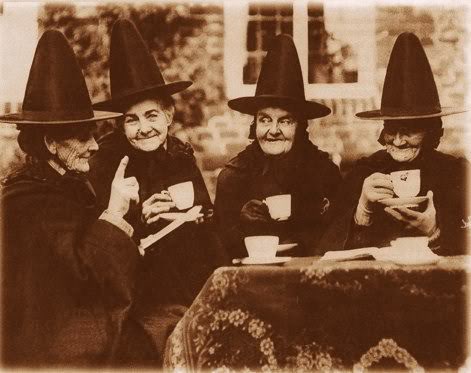
Have loved these Welsh ladies from the first time I spotted them on a postcard and shared them with my "goilfriends." Did some reading into the history of their hats (wonder if they ever had a clue they looked like witches in them?!) and learned that they first appeared in the 1830s and were likely adapted from men's hats of the period.


I stumbled across this image when I started researching "Crones" in art. At the same time I found this, I read that grandmothers were usually the designated storytellers. This painting by the French artist Louis-Leopold Boilly is entitled "and the Ogre ate him up!" (early 19th c.)
Love the expressions on the faces of the children!


John Everett Millais' "Autumn Leaves" (1856).

Fall, leaves, fall

BY EMILY JANE BRONTË
Fall, leaves, fall; die, flowers, away;
Lengthen night and shorten day;
Every leaf speaks bliss to me
Fluttering from the autumn tree.
I shall smile when wreaths of snow
Blossom where the rose should grow;
I shall sing when night’s decay
Ushers in a drearier day.

Source: Poets of the English Language (Viking Press, 1950)

~~~~~~~~~~~~~~~~~~~~~~~~~~~~~~~~~~~~~~~~~~~~~~~~~~~~~~~~~~~~~~~~~~~~~~~~~~~~~~

Sunday, October 2, 2011

This isn't your mother's menopause

Maybe I've always had too much testosterone to go gently into menopause by nagging for grandchildren, puttering in the garden and waxing nostalgic over crap that happened 30 years ago. My menopause feels more like a certain type of man's -- not the guys who go all soft and contemplative in their dotage, but the stereotypical silver fox in the Ferrari he can finally afford, cruising sweet young 40-somethings at the upscale bar. Ouch; yes, I'm that guy.

I went through a mopey period. Ten years of a mopey period, to be exact. My weight ballooned. Everything ached. I could only find a special occasion dress in the fat woman's department at Nordstrom's. I'd stand in front of my kitchen window and watch people jogging, biking, being alive, and think, "Gee, that used to feel good. That used to be fun. I can't believe I used to do that." Then I'd waddle back into the family room with a bag of chips and watch more television. It didn't matter. I was old; old people are supposed to act this way. On days when the estrogen was especially volatile, I would shift into manic phase by yelling and throwing things. I was like Liz Taylor in her later days, only without the bling--so actually like Liz Taylor as Martha in "Who's Afraid of Virginia Woolf," only without the sex.

The wakeup call for me was seeing the pictures from my best friend's daughter's wedding. Even fully made up and dressed to the nines, I didn't just look old, I looked dead. Well, yes, I may be old, but I'm not dead yet.

So over the past year I stopped dyeing my hair, lost 40 pounds and rediscovered physical activity -- biking, skating, jogging, kickboxing and recreational sex. I'm successfully passing for 10 years younger than I actually am, and yes, I fully intend to continue the deception for as long as I can get away with it (harder than you think; when I say I remember the '80s, I have to foster the illusion that I remember them as a high school student, not as someone who actually voted for Michael Dukakis, even though I have the campaign buttons to prove it).

In one way I guess I can say I'm rediscovering the essential self that got set aside--physically when the procreative imperative took over at puberty, and mentally/emotionally after I became a mother. In another, deeper way, however, I'm morphing into the woman I was meant to be all along -- the woman that isn't fettered by the fears, insecurities and self-consciousness that go along with being young. I'm too damn old to give a fuck what people think of me. And that's a healthy attitude for any age.
Has all this second-adolescence activity made me a less contemplative, more shallow person? Perhaps. But since I already went through old age during my real adolesence (oh so much bitter reading of Herman Hesse, writing bad poetry and simultaneously mocking and envying my popular classmates!), it seems to be balancing out perfectly.

As far as being a wise crone dispensing sage advice, unless I can look and act like Maria Ouspenskya counseling Lon Chaney, I'm not interested. Yes, you can ask me for advice, but my responses are less likely to sound like the Dalai Lama and more like Coach Mike Ditka: get off the cross, man up, and tighten up that offensive line. (That's another weird thing about menopause: Along with the relentless hot flashes, in the last year I've also developed and taste for an an understanding of football.) And of course, the ever-popular, "You need to get laid."
Heck, it worked for me.

Friday, September 30, 2011

The Summons


Snaky necks black
Among cornshocks
Be-In of clans,
Feathered coverlet,
Mulched field
High blue above,
Walking, chatting, resting.

Some fly in,
Wings bowed
Dump speed for landing.
Some fly out,
On their way to
Lost Pangea.

As it is,
So it was.
Faithful through eons,
Through cataclysms of
Fire,
Frost,
And our slaughter,
Hearing, beyond
Man's stunted senses,
Magnetic Summons--

Fly Now,
Oh Brave Children
Of Archeopterix.


http://www.julietwaldron.com

Wednesday, September 28, 2011

L'autre, la même

L'autre, la même


Streetskin moist with rain
And you are working your dark dance
in my soul this morning
The sidewalk splays a single pine quill in my path
like a sensual challenge
reminding me of porcupines,
and wolves coursing through
heavy-lidded night
I know where you run
washing into me, pulling me,
like an ocean on long forgotten tides
and how we both fear damage
But my world turns autumn in your presence
lush and full of burgundy stillness
It is fruition we offer one another
So range with me,
and we will leap burning peaks
where they raise themselves
from ancient waters

Monday, September 26, 2011

September Birthday Crones


Visit a new monthly feature on Crone Henge ~ a birthday page of quotes saluting the creative spirit of women.

Black Madonna


"I salute you, Black Virgin, each day that I see you and that I live."
----chant in honor of the Black Virgin of Biarritz


She’s here and there all across Europe. There are many explanations of what brings her shining black face to the West. Is she Isis come out of Roman North Africa? The religion of Isis was widespread in the later days of the Empire and it was carried by the army into the new northern territories. Many European Isis shrines are sited at ancient holy sites, by sacred wells and springs, all of which once belonged to Brigit, the Celtic Triple Goddess. It’s perhaps a case of one religion supplanting another, and then, in its turn, being supplanted by the militant tide of Christianity. So, instead of Isis carrying her son Horus, these dark ladies were viewed as an African Mary carrying her son Jesus.

An alternate explanation may be that today’s Black Madonna is yesterday’s Goddess of the Dark Moon. After all, in the old religions, the Triple Goddess who ruled the earth was symbolized by the moon, and the moon has phases. New Moon represented the maiden, Full Moon, the Mother, while the Dark of the Moon represented the Crone, the original version of a divinity which was “three in one and one in three.”

Southern Italy was colonized early on by Greeks, named by them Magna Graecia. Intermarrying with the Etruscan people, they worshipped the Goddess, Demeter, or Cybele—the earth mother who regenerates every spring—in their temples. Sometimes, this lady is known as “The Ancient Spider.” This goddess weaves and spins, as do the Fates, and many powerful goddesses in many different traditions, from Athena to. She also possesses her devotees with the bite of her creature, the tarantula, and then frees them in a restorative dance which is sacred to her, and which still survives: Tarantella.

In later societies where men ruled, women were deprived of all rights and of their ancient sacred status as givers of life. Then Tarantella provided a form of emotional release for the frustrated, depressed and frequently abused “lesser sex.” Perhaps this explains its survival and practice into the present.

In Puglia, in the Basque region of Biarritz, in Barcelona, in France,in Calabria, and in Montserrat in Spain, all ancient bastions of the Roman empire, Black Virgins are still found. Their festivals are devoutly celebrated, for each Virgin has been the object of veneration, longing and pilgrimage for well over a thousand years.

“I come a long way to salute you, Maria. I come to ask for a miracle, and I won’t leave until you grant it to me. Perform this miracle, Maria! Perform it out of your mercy.” –Canto della Madonna Di Montserrato as sung by Alessandra Belloni in her CD, Dance of the Ancient Spider.
http://www.alessandrabelloni.com/music.php

http://www.julietwaldron.com

Sunday, September 18, 2011

Old times—The rooster in the Kitchen Garden


My mother is dead now, though she still angrily haunts my dreams. Difficult as our life together was, as time passes, I find myself wishing I’d listened more attentively to her stories of old times.

My mother, Dorothy, was born in 1920, which is getting to be a long time ago. She had many every day experiences with a kind of life that’s shadowy hearsay for my grandchildren. When Dorothy came into consciousness, Albert, her father, was working toward his PhD. His father, an upstate NY dairyman had land and a little money , but also, unlike many of his peers, he ardently believed in the value of a good education. My grandpa was not the only one of his children he sent to Cornell. He even sent a daughter there, and despite the prejudices of the time, she too ended with a doctorate. My grandfather, Albert, then earned a scholarship to Princeton, and was filling in the inevitable gaps in his income as a graduate assistant and tutoring the less-motivated sons of the rich. In summers, though, he brought his young family back to the farm. There he worked as he had as a boy, and his wife helped in the kitchen and house and took care of their small daughter.

Dorothy loved her grandfather’s farm, even though there were things that scared her. Behind the big red brick farmhouse was a large kitchen garden. At certain times of year the chickens were allowed in to clean up bugs and help themselves, though they were generally banned from that area. Still, the time of year would come, after the peas and beans and when the lettuce has gone to seed, that is time for a bit of clean-up. They were loosed to peck and scratch before the second crop went in.

These were times of trial for Dorothy, because along with the hens came the rooster. He didn’t limit his displays of dominance to other chickens, but always lurked along the path that led across the garden to the backhouse, hoping to ambush people on their way there. On the first summer there that she clearly remembered, her own mother had bronchitis and was upstairs in bed, leaving the woman’s share of the work shorthanded. She told me of having to pee mightily, but not daring to go, and finally weeping. Spanking was in order for children who wet their pants in those days, even when they were caught between a rock and a hard place. Her grandmother, busy canning, or laboring to cook for the family and hired help at the big wood stove, didn’t have an extra minute to escort her across the garden. Mom says she remembers her grandmother saying with exasperation, “Just pick up a stick of kindling and hit him!” before turning back to the bubbling pots.

My mother was small for her age and the rooster seemed a monster, tall enough to look her in the eye. She said she did as she was told, but could still recall the terror when that big old red rooster came charging out of the berry bushes at her. She threw lots of kindling that summer, and sometimes she hit the feathered bully, but it only gave him a moment’s pause. She’d have to take to her heels and run. Next there’d be those awful seconds of struggling with the heavy door before slamming it shut. Chest heaving, heart pounding, she pant'd in the odorous interior, lit only by the moon and star carved in the door. One day, while her mother was sick, she waited too long and peed herself as the rooster chased her. She had to hide her underwear under her pinafore before taking an even more circuitous route back inside.

Friday, September 16, 2011

The Conspirator

Innocent or guilty? That question has been repeatedly asked about Mary Surratt, a widow in her mid-forties, since the death of Abraham Lincoln on April 15, 1865. First off, even though I have researched the Civil War extensively, I watched the movie with little knowledge surrounding the events of Lincoln's assassination.

For those who are unfamiliar with the story, Mary Surratt is the alleged lone female conspirator among eight who were charged with the assassination of President Lincoln. Along with four others, she was hung in July 1865 and was the first woman to have been executed by the U.S. government. In the movie, young attorney, Frederick Aiken, represents her against his better judgment. The movie casts doubt on Mary's guilt, and Aiken tries to uncover the truth.

For the most part, costuming and historical sets were excellent. I have quite a bit of knowledge about military trials of the era, and the movie puzzled me in that regard. It came across as a mix of a military and civilian trial, but the average viewer isn't going to notice that detail. There were many more individuals involved in the actual trial than the movie portrayed, but too many characters would have made the story confusing.

I have read criticisms from historians that Mary Surratt led to her own downfall with lies (since I haven't researched the subject myself, I can't make any conclusion), nor did she defend herself. A defendant wasn't allowed to take the stand in their own defense in military trials during the 1860s. They could bring in as many witnesses as necessary in order to attempt to prove their innocence, but they were only allowed statements to the court.

The biggest criticism I've read about the movie from other reviewers is that slavery was never mentioned. Those reviewers show their ignorance. While slavery was certainly an important aspect of the Civil War, it was much more complex than any single issue. Mary Surratt had owned slaves, but the movie had nothing to do with slavery. In fact, apparently one of her former slaves testified in her defense. This was never mentioned, nor were statements from a co-conspirator, who insisted several times that she was innocent.

Whether Mary Surratt was guilty or innocent is a question that may never be answered. What is clear is that she never received a fair trial, and in that regard, the movie was accurate. But then, even if she had received a trial by her peers, with the judicial system of the time only allowing white males as judge and jury, could she have ever received a fair trial?

I enjoyed The Conspirator. It kept me captivated, and it's message is as relevant today as it was in the 1860s.

Kim Murphy
www.KimMurphy.Net

Wednesday, September 14, 2011

The Dance of the Black Madonna

Dancing with the Shadow Beings

I became a Dolphin

leaping in the Ocean

leaping in the Sea

twisting and flying in the air

Fast, fast, past reefs of colours

bursting red, yellow, blue


Hauled back to dance again

on the white sand

to dance at the feet of

the Black Madonna

to be welcome inside Her mantle

to swallow a silver key in the darkness

that I may gather tears of all those who bring them

and lay them at Her dusky feet


For She has the Power to transform sorrow

into a purple veil dance

Dance of brown feet

on the timeless white sands

of the Lower World


White shore, sand and ocean

day becomes night

in the purple veil dance of the Madonna,

Who sees and knows all things

I am drained of my sorrows

and all my dark teachers come

dancing with me upon the sands


There is healing in the darkness

All pain is bearable

All pain is transformed here

to dance and stars and sand

Where God is Bhairava

and Goddess every Dark Mother

compassion is deep and violet

He is here and She is here

dancing, dancing

And as I reluctantly go

the shadow stretches out in farewell;

I kiss its graceful fingers

As they recede down the passage of dark joy

Monday, September 12, 2011

Crone Voyage

Entering Cronehood feels like going on a journey; destination unknown, route unspecified. I don't know what to pack, or what suitcase to bring. Does anyone have the official map?

There have been a dozen full years of changes since my Croning Celebration when I turned 50. My Goddess circle, The Laughing Yonis, celebrated with a party filled to the brim with chocolate, laughter, wine and wisdom. I have been trying ever since to grow into the Wise Woman role they envisioned and personified so well.

Today, preparing for a trip to Kelowna I found myself in Sears, equipped with list and measuring tape, comparing sizes, weights, and handle lengths. A fellow shopper, also a woman-of-age was there on a similar quest and we entered into a brief but satisfying friendship of information sharing and wry laughter about our diminished mobility.

On my brighter days I know the wisdom I am seeking is not found in knowing the answers but in asking the thoughtful questions, and taking delight in shared laughter. The more I can remember these simple truths, the closer I become to being a wise woman crone and not the nasty witch of Menopause Hell. Now where did I put that list?

Monday, September 5, 2011

My Time & The Doctor


David Tennant as The Doctor

I was living in England with my mother, going to The School of St. Claire in Penzance as a day student. We lived in the end unit of a stone row house, just as you imagine a British working class neighborhood. We had just moved out of an artsy Mousehole hotel to less expensive Newlyn, to the last building on the top of the hill above the harbor. Behind us was a field with dairy cows and a stubby, well-worn stone circle, through which I walked every morning, taking the back way over the headland into PZ. We rented our telly and paid license fees, like everyone else on the street, and I began watching my first regular doses of English entertainment. It was black and white in those days, rather different from what I’d been accustomed to back in the States.


I only saw two shows containing the original Doctor, William Hartnell. Although I remember keenly enjoying Dr. Who, it was never completely clear to me what the heck was going on. I remember being thrilled to realize that this show was not only about history—and with costumes which were actually period correct (astonishing in and of itself as this was the early sixties)—but also about the science fiction notion of time travel. The Doctor and his two companions eventually escaped from trouble inside their odd little time machine—in this case, a blue police call box, the kind I’d seen standing, by the sixties dusty and unused, on street corners here and there in London. They called this handy device the TARDIS*.

Well, wow! Stories about history and time travel all in one show! The main character was not only mysterious, aged and professorial, but a little sinister, too, as if he was not entirely to be trusted. As someone who liked fantasy and science fiction but who was also loved to read about famous characters in history, I couldn’t help but be intrigued. Unfortunately, I never saw any more than those two shows. Soon Mom and I pulled up stakes again and headed for Barbados. In those days, the West Indies had no television.

Years later, The Doctor and I reconnected. My kids and I were sitting on the floor together watching public television on our Zenith, also parked on the floor. (In those days furniture was something of a luxury.) A British import began. Lo and behold--there was my time traveler and his blue box—again! Of course, the original doctor had gone. The new one was still domineering and mysterious, but far less of a stuffy old professor. Instead he now appeared to be in his forties, with a gorgeous head of wavy hair and Victorian get-ups by way of Carnaby Street. John Pertwee might have just stepped out of the Yellow Submarine.

Okay, I thought, I’ll go with the flow. My brief, earlier acquaintance with that absent-minded elderly Doctor was a pleasant memory. This, I realized, would be a great show for the kids to watch while I made dinner. (In those days 30 Minute Meals was not a “marketable idea,” just the way everybody cooked.)

My boys became fans, but almost immediately there came a change in Doctors, as reported to me by my oldest son. He was about equally disturbed and fascinated by the fact that the main character in a series might abruptly “regenerate” into someone else, all while essentially playing (more or less) the same character. Tom Baker immediately captured our fancy, perhaps because his clothes were utterly Boho- trippy. The hat, the scarf, the manic manner, the comic timing, his diction, and his “funny walks”—Baker was like a speaking, Oxford-educated Harpo Marx . The kids, and their Mom too, adored Baker, and we watched the show faithfully during the years of his reign. My youngest son begged his aunt to knit him a floor-sweeping Whovian scarf for Christmas, and we hunted used clothing stores for a cool old hat to go with it.

Time passed for us, as it never quite does in the TARDIS. The kids got older and began to lose interest when the Doctor "regenerated" again. We never entirely warmed to the handsome, dapper Peter Davidson with his question marks and 1890s university cricketer’s garb. We drifted away.

Years went by. The kids grew up and had kids of their own. I became a senior. Time Lords (the Doctor's species), however, regenerate with some regularity. And although I hadn't been paying attention, he’d done it again.

One day I was channel surfing and happened upon BBC America. And Wa-Hoo KA-ZAM! There he was, a brand new Doctor. This incarnation had a budget and enjoyed all the benefits of the CG revolution. Somewhere in the hiatus, the hoary old Doctor had become a “valuable property.” Forty-seven years after our first meeting, I’d found him again.

You might think I'd be too old now for a "kid's show," because I'm wrinkly and gray, but I'm still turned on by Doctor Who's fizzy cocktail combo of history and space/time travel. It's been great fun to be a fan at the same time my grandgirls--21and 12. Not only monsters, but more ordinary human problems are regularly explored here, such as the inevitably of change and the blessing of friendship. Rarified concepts like immortality, the persistence of evil, and the--let's face it--scariness of eternity are also pondered. There are many reasons why this series, conceived in the early days of television, is still going strong. I may myself soon vanish out of Time, but it seems there will always be another Doctor.


Doctor Who, Greatest Show in the Galaxy.


* TARDIS= Time and Relativity Dimensions in Space. Sort of silly, but there you are. ;)